Already hold a Latvian residence permit? What changed in 2026
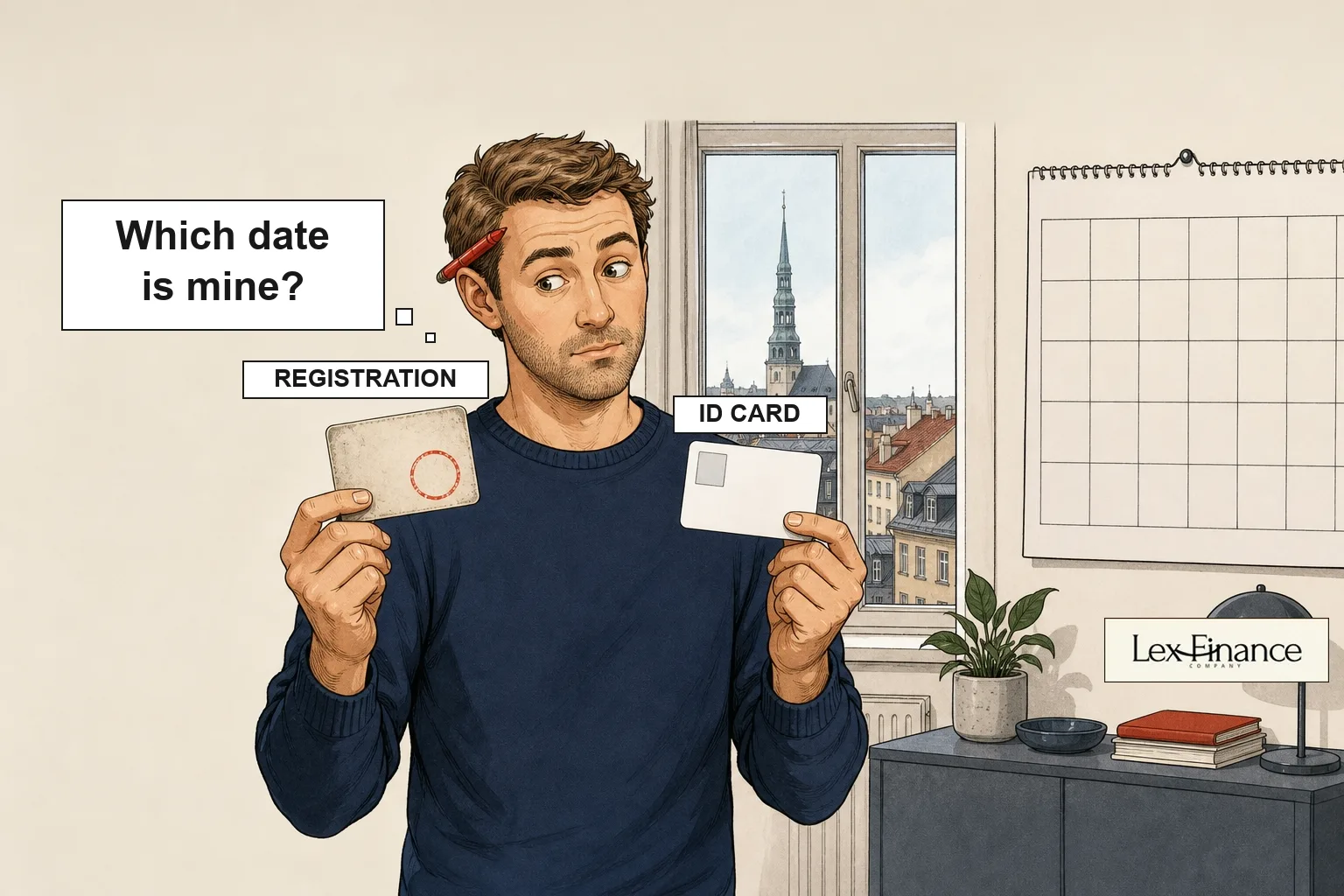
One mark on the calendar is now enough. The trick is putting it in the right square.
Latvia's new Immigration Law (Imigrācijas likums) came into force on 15 September 2026. If you already hold a temporary residence permit for work, study or family reasons, the key question is whether it was issued under the previous law or the new one: the answer affects its expiry date and what you need to do next. The law also changes how long new permits are issued for, the language of documents when you apply again and the conditions for permanent residence.
Information correct as at 25 October 2026.
If your permit was issued before 15 September
Your permit does not become invalid simply because the law has changed. But you do need to know which date now applies to it. A temporary residence permit issued before 15 September remains valid until the end of its registration period or, if no registration period was set, until the end of its period of validity (point 6 of the transitional provisions).
If your permit has a registration period (for example, if it had to be registered every year), the permit ends when the current registration period ends, even if your right of residence was originally granted for longer. To stay in Latvia until the end of the period you were granted, you need to apply for a further permit, and that application is assessed under the new law (point 7). If the new law does not entitle you to apply for a temporary residence permit, a special procedure applies (also point 7).
- Applications for a visa or a temporary residence permit submitted before 15 September are assessed under the previous law, and any visa or permit granted on them is issued under that law, even if it is issued after that date (point 4).
- Applications for a permanent residence permit submitted before the same date are assessed under the new law (point 5). This difference is easy to miss.
If your permit was granted on the basis of an investment under the previous law, different transitional rules apply. We explain what has changed for investors in our article on the new Immigration Law and investor permits.
New permits: same expiry date as your residence permit card
Permits issued under the new law expire on the same date as the holder's residence permit card (the ID card Latvia issues to foreigners) and no longer need to be registered annually. That is simpler, but without annual registration you may have fewer reminders, so it is worth noting the card's expiry date in your calendar straight away.
Which date counts for your permit
A temporary residence permit applied for before 15 September 2026 is issued under the previous law, even if it is issued later (point 4).
Work and study: what has changed
The new law has reduced the maximum validity period for several types of work-related residence permit. The maximum for an EU Blue Card remains two years. Different validity periods apply to other categories.
| Permit basis | Before 15 Sept 2026 | Now |
|---|---|---|
| Employment | up to 5 years | up to 1 year, except where the employer is a micro-enterprise taxpayer (Section 27(1), point 12) |
| EU Blue Card | up to 2 years | 2 years; if the employment contract is for two years or less, the contract term plus 3 months, but no more than 2 years (Section 27(1), point 13) |
| Intra-company transferee (manager or specialist) | up to 3 years | up to 1 year (Section 27(1), point 15) |
If you receive a one-year residence permit for employment, start preparing the documents for the next application early. Our page on residence permits in Latvia for employment explains how the application works now.
Students face a different change. If a student is not a citizen of a NATO member state and received their permit as a first- or second-cycle higher education student (Section 27(1), point 21), their family members cannot apply for a permit on that basis (Section 27(3)). The restriction does not apply to doctoral students. More on residence permits for studies at an accredited higher education institution.
Changes must be reported within five working days
If the circumstances on which your temporary residence permit was granted have changed or no longer exist, the Office of Citizenship and Migration Affairs (PMLP) must be informed immediately, and in any event within five working days. The previous deadline was three working days. The duty lies with the inviting party, such as your employer; you must report the change yourself only if you have no inviting party (Section 39(2)).
Reporting a change does not by itself mean the permit stays valid. Whether it does depends on the specific ground, and that is worth checking separately.
Applying again: documents in Latvian
For a visa and a first temporary residence permit, documents may be submitted in Latvian or English. For a further temporary residence permit and for a permanent residence permit, they must be in Latvian (Section 5(1)). The inviting party, such as an employer, submits information, explanations and documents in Latvian only (Section 5(2)). If you applied in English the first time, documents in other languages will now need a Latvian translation, so allow time for it.
For residence permit applications, PMLP normally replies within 30 days of accepting all the required documents (Section 33(1)). If that deadline cannot be met for objective reasons, it may be extended, but not beyond four months from the day all the submitted documents were received (Section 33(4)). No further extension is possible (Section 33(5)).
Permanent residence: five years and A2 Latvian
Under the new law there is a single permanent status, EU long-term resident status, granted on a new application or when an existing permit is registered. A permanent residence permit in Latvia is not issued as a first permit in any category.
If you live in Latvia on a residence permit, the general rule is that you can apply after five years of continuous residence immediately before the application. Three conditions must be met at the same time: sufficient means to support yourself and your dependent family members, Latvian at A2 level or higher, and a completed course on Latvian culture and history (Section 31(1)). The law sets special rules for certain situations.
Under Section 31(3), residence counts as continuous if your absence from Latvia has not exceeded six consecutive months or 10 months in total. It is safer to plan so that you stay within both limits. An absence can be treated as justified if it was caused by circumstances beyond your control, such as illness. EU Blue Card holders have wider limits: 24 consecutive months or 18 months in total outside the European Union.
If you often work abroad, start counting your days away now rather than at the end of year five.
Still to come: December 2027
Already in the law. Section 48 on the early integration programme comes into force on 31 December 2027 (point 20 of the transitional provisions). The programme consists of a course on Latvian culture and history and learning Latvian to at least A1 level. It will be compulsory where the total term of one or more consecutively issued temporary residence permits is at least 18 months. There are many exemptions, including people staying in Latvia for full-time study at a higher education institution or college accredited in Latvia, intra-company transferees and people living in Latvia on a permit issued under the rules in force before 15 September 2026 (Section 48(3)). The foreigner pays for the programme (Section 49(1)).
Not yet decided. The content, scope and procedure of the programme will be set by the Cabinet of Ministers (Section 49(2)), so some details may still change.
Other Cabinet regulations under the new law must also be issued by 1 December 2027. Until they take effect, but no later than that date, the earlier Cabinet regulations listed in point 3 of the transitional provisions continue to apply, insofar as they do not contradict the new law.
What to check if you already hold a permit
- Whether your permit was issued before 15 September 2026 or under the new law. If you applied for a temporary residence permit before that date, it is issued under the previous law even if you received it later. For an older permit with a registration period, the end of the registration period is the date that counts; for a permit issued under the new law, it is the expiry date of your residence permit card.
- Whether the circumstances on which your temporary residence permit was granted have changed or no longer exist. If they have, the inviting party, or you if there is none, must inform PMLP immediately, and in any event within five working days.
- The language of your documents: for a further permit, they must be in Latvian.
- Your plans for permanent residence: days spent abroad and your Latvian level.
General information on obtaining a residence permit in Latvia is on our service page.
Sources: Immigration Law of Latvia (adopted by the Saeima on 20 August 2026, in force since 15 September 2026), PMLP announcement (15 September 2026, in Latvian), LV portāls explainer (15 September 2026, in Latvian). Checked on 25 October 2026. This article is not individual legal advice.
SIA Lex & Finance, a legal and accounting firm in Riga. Registration number 40203239265. The firm prepares documents for residence permits, visas and company licences. Decisions on invitations and residence permits are taken by PMLP, not by the firm.
Kalpaka bulvāris 10, Riga
Phone +371 25155167
Email consulting@lexfinance.lv
Checked against the Immigration Law of Latvia (in force since 15 September 2026) on 25 October 2026.